





PRODUCTDETAILS
-
Catalytic combustion equipment
-
Single Baghouse Dust Collector
-
Baghouse Dust Collector
-
Industrial Dust Collector
-
Filter Bag
-
Filter Bag Cage
-
Pulse Jet Valve
-
Screw Conveyor
-
Rotary Airlock Valve
-
Ventilation Butterfly Valve
-
Knife Gate Valve
-
Grinding Downdraft Table
-
Activated Carbon Adsorption Box
-
UV photocatalytic waste gas treatment
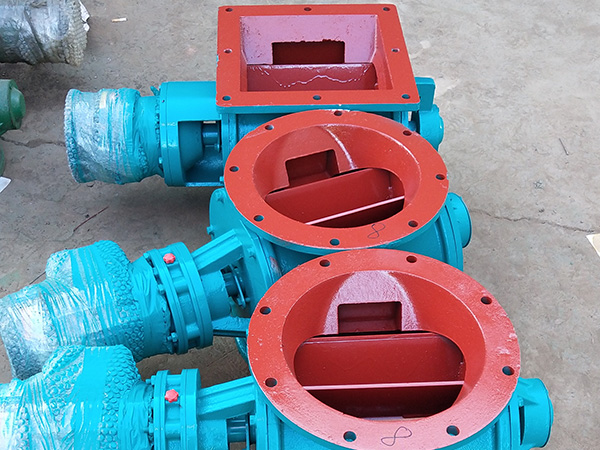
Rotary Airlock Valve
Rotary Airlock Valve,also commonly referred to as a rotary feeder,star valve,rotary lock,or airlock feeder,is a critical mechanical component in industrial bulk material handling and pneumatic conveying systems.Its core function is to meter and discharge dry,free-flowing bulk solids—such as powders,granules,pellets,dust,and crystals—from hoppers,silos,bins,cyclones,or dust collectors while maintaining an airtight seal to isolate pressure differentials and prevent air leakage.
Working Principle
The valve operates via a precisely machined,multi-vane rotor that rotates within a cylindrical housing.As the rotor turns,material from the upper inlet fills the pockets between the vanes.The continuous rotation carries the material around the housing and discharges it through the lower outlet.The overlapping vanes maintain a constant mechanical seal between the inlet and outlet,effectively blocking cross-flow of air or gas.This design ensures stable system pressure,prevents pressure loss or"short-circuiting,"and enables consistent,controlled material flow.
Key Components
Housing:Constructed from cast iron,carbon steel,or stainless steel,forming the main body with inlet and outlet flanges.
Rotor:A rotating shaft with multiple(typically 6–12)vanes,designed to form sealed pockets for material transport.
Drive System:Consists of an electric motor and a gear reducer to control rotor speed and torque.
Seals&Bearings:Shaft seals and end-plate bearings to prevent dust ingress,minimize air leakage,and ensure smooth rotation.
Main Functions
Pressure Isolation:Acts as a barrier between high-pressure and low-pressure zones,preserving pneumatic system efficiency.
Flow Regulation:Provides volumetric feeding,allowing adjustable and consistent discharge rates.
Dust Containment:Prevents fine particles and dust from escaping into the workplace,supporting environmental and safety compliance.
Material Discharge:Reliably unloads bulk materials from collection points to conveying lines or processing equipment.
Common Types
Standard Drop-Through Valve:General-purpose design for gravity discharge of most dry materials.
Blow-Through Valve:Optimized for pneumatic conveying,with a through-flow design to directly feed material into the air stream.
Heavy-Duty Valve:Reinforced structure for abrasive materials like cement,sand,ore,and fly ash.
Sanitary Valve:Polished stainless steel construction for food,pharmaceutical,and chemical applications requiring hygiene and cleanability.
 BLOGS
-
Stainless Steel Filter Cage vs Galvanized: Which to Choose
2026-10-23 09:48:36
-
How to Choose a Custom Filter Cage Manufacturer: A Buyer's Guide
2026-10-22 09:45:40
-
Filter Bag Micron Rating Explained for Industrial Filtration
2026-10-20 04:28:54
-
Screw Conveyor Capacity Calculation: Complete Engineering Guide
2026-10-19 04:13:28
-
Industrial Screw Conveyor System: Complete Working Principle and Applications Guide
2026-10-18 02:39:26
CONTACT US