





PRODUCTDETAILS
Sinter Plant Dust Collection
Dust collection is a critical environmental protection and production optimization process in sinter plants,as sintering operations generate large amounts of dust throughout the entire production cycle.The dust contains complex components,including iron oxides,heavy metals(such as zinc,lead,arsenic),and toxic substances,which not only pose serious threats to the health of on-site workers but also pollute the surrounding environment and corrode equipment.An efficient dust collection system is essential to meet environmental emission standards,reduce resource waste,and ensure the stable operation of the sinter plant.
1.Dust Sources in Sinter Plants
Dust generation in sinter plants is widespread,covering raw material processing,high-temperature sintering,and finished product treatment,with the following main sources:
-Raw Material Preparation System:Accounting for more than 60%of the total dust output,this includes dust generated during the unloading,stacking,crushing,screening,batching,and mixing of iron ore concentrate,flux(limestone,dolomite),and fuel(coke powder,coal powder).For example,open stockyards produce serious fugitive dust due to wind,while crushing processes generate alkaline dust or combustible coal dust,and mixing processes may emit high-concentration aerosols if water wetting is insufficient.
-Sintering Host System:As a key high-temperature pollution source,dust is generated during material distribution,ignition,sintering reactions,and tail ore discharge.The sintering reaction zone(at 1300℃)causes gasification of low-melting metals(such as lead and zinc),which condense into submicron heavy metal dust in subsequent flue gas.Hot crushing of sinter ore at the machine tail also ejects high-temperature dust particles,which can be oxidized when exposed to air.
-Flue Gas Treatment System:Secondary dust is generated during the operation of dust collection equipment and desulfurization and denitrification processes.For example,short-term high-concentration fine dust is emitted during electrode plate rapping and ash cleaning of electrostatic precipitators,and unreacted fine powder may escape during desulfurization.
-Auxiliary Processes:Dust is generated during the screening and transportation of hot return ore,as well as during the recycling of dust ash.The recycling of electrostatic precipitator ash may cause fugitive dust due to differences in density.
2.Core Dust Collection Technologies
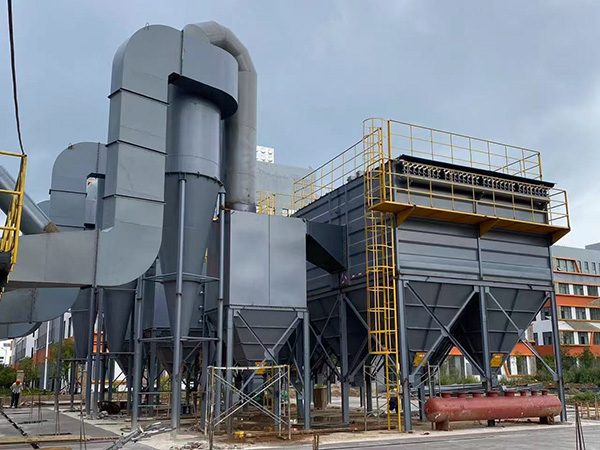
The selection of dust collection technology in sinter plants is mainly determined by the dust characteristics(particle size,concentration,corrosiveness)and emission requirements.The mainstream technologies currently include bag filters,electrostatic precipitators,and sintered plate dust collectors.
2.1 Bag Filters(Pulse Regeneration Type)
Bag filters are widely used in sinter plants due to their high filtration accuracy and strong adaptability.The core component is the filter bag,which is usually made of high-temperature and corrosion-resistant materials such as PPS(polyphenylene sulfide)or PPS+PTFE(polytetrafluoroethylene)composite materials to adapt to the high-temperature(120-180℃)and humid environment of sinter flue gas.The working principle is to use negative pressure generated by a fan to suck dust-laden air into the dust collector;dust particles are intercepted by the fiber layer of the filter bag,and clean gas is discharged through the bag.When dust accumulates on the bag surface,a pulse jet system uses high-pressure air to shake off the dust into the ash hopper,realizing the regeneration of the filter bag.Pulse regeneration bag filters can control the residual dust content of emitted flue gas to 20 mg/m³,meeting strict environmental standards.
2.2 Electrostatic Precipitators
Electrostatic precipitators are suitable for treating large air volumes and high-concentration dust,and are often used for dust removal of aspiration air in sinter shops and flue gas from sintering machines.The working principle is to ionize the flue gas through high-voltage electricity,make dust particles carry electric charges,and then adsorb them on the positive and negative plates.The collected dust is transported to the batching or mixing department through pneumatic conveying and returned to the sintering process for recycling.However,the dust in sinter flue gas has high specific resistance,large temperature fluctuations,and high humidity,which easily leads to problems such as electrode plate corrosion,deformation,and insufficient rapping force,affecting dust collection efficiency.Through transformation measures such as merging equipment,using high-performance coatings,and optimizing rapping technology,the dust emission concentration can be reduced from 300-800 mg/m³to below 100 mg/m³.
2.3 Sintered Plate Dust Collectors
As a new type of dust collection equipment,sintered plate dust collectors use rigid sintered plates(usually made of polymer materials such as polyethylene)with a microporous structure as the filter medium.Their working principle is surface filtration:when dust-laden gas passes through the sintered plate,dust particles larger than the micropores are intercepted,and clean gas is discharged through the micropores.Compared with bag filters,sintered plate dust collectors have the advantages of long service life,low energy consumption,easy ash cleaning,and stable filtration efficiency.The pulse jet cleaning system does not affect the filtration effect,and the folded design expands the filtration area,saving equipment space.They are especially suitable for the recovery of ultra-fine powder and high-value-added powder in sinter plants.
3.Composition of the Dust Collection System
A complete sinter plant dust collection system is composed of multiple components that work together to ensure efficient dust capture,filtration,and treatment.The main components include:
-Dust Capture Device:According to the characteristics of different dust sources,different types of hoods are used,such as fully enclosed hoods for the sinter machine tail(to prevent dust escape in turbulent air flow)and telescopic enclosed hoods for belt transfer points(to reduce dust diffusion).
-Dust Conveying Pipeline:It is responsible for transporting dust-laden gas from the dust source to the dust collection equipment,and its design needs to avoid dust accumulation and blockage.
-Negative Pressure Fan:As the power core of the system,it provides airflow and total pressure to overcome equipment and pipeline resistance.Centrifugal fans are usually used,and frequency conversion control technology can be adopted to dynamically adjust the fan speed according to dust concentration,realizing energy saving.
-Filtration Equipment:The core part of the system,including bag filters,electrostatic precipitators,sintered plate dust collectors,etc.,which completes the separation of dust and gas.
-Dust Handling and Recycling System:It includes ash hoppers,rotary feeders,and pneumatic conveying equipment.The collected dust is transported to the batching or mixing department for recycling,or processed into non-toxic and harmless gypsum products for use in cement production and construction after desulfurization treatment.
-Control System:It controls the operation of the fan,pulse jet system,and rotary feeder to ensure the stable and efficient operation of the entire system.
 BLOGS
BLOGS
-
Maintenance Measures Before Long-Term Shutdown of Baghouse Dust Collector
2026-04-21 10:55:33
-
How to Select Filter Bag Material of Baghouse Dust Collector According to Flue Gas Characteristics
2026-04-21 10:53:08
-
Low Pressure Drop(Sudden Differential Pressure Drop)of Baghouse Dust Collector:Filter Bag Breakage or
2026-04-21 10:50:35
-
How to Select Baghouse Dust Collector According to Dust Characteristics
2026-04-21 10:48:21
-
Requirements for Flange Parallelism,Coaxiality and Flow Direction During Ventilation Butterfly Valve
2026-04-21 10:46:04
CONTACT US