





BLOGSDETAILS
Welding Downdraft Table for Fume Extraction in Workshops
Author:shangcheng Time:2026-10-25 18:40:30 Click:182
Welding fume is a complex mixture of metal oxides generated as the arc vaporizes the electrode, filler, and base metal. Some of its components—manganese and hexavalent chromium among them—are recognized health hazards at occupational concentrations. The most effective control is capture at the source, before the fume disperses into the breathing zone and the shop air. A welding downdraft table does exactly this: the workpiece sits on a perforated table, and fume is drawn downward through the surface into a filtered plenum. This article explains how the capture works, what determines whether it actually protects the welder, and the compliance factors that shape a sound specification.
What a Welding Downdraft Table Does
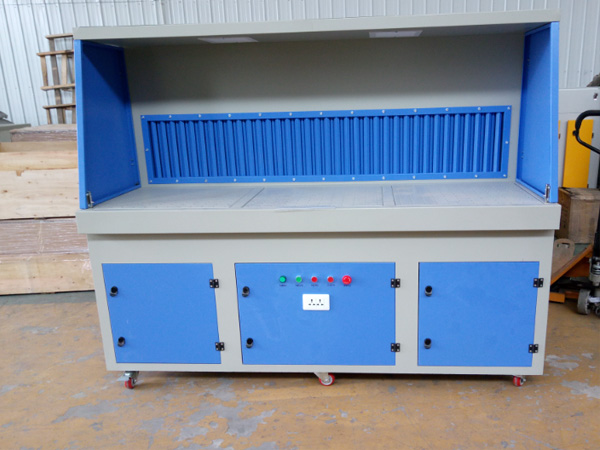
The table is a work surface with a slotted or perforated top connected to a fan and filter section, either built in or ducted to a central collector. As the welder works, the downward airflow pulls the rising fume into the table before it can rise into the face. A welding downdraft table is a source-capture device: its value is proportional to how completely it intercepts the plume at the arc, which depends on airflow, table design, and how the welder positions the work. It is not a room cleaner; if the fume escapes the capture zone, it becomes a general-ventilation problem.
Why Weld Fume Must Be Captured at Source
Weld fume contains fine particles—most below a micron—that penetrate deep into the lungs, and metal constituents whose occupational limits are low. Manganese exposure is associated with neurological effects, and hexavalent chromium, present in stainless and some alloy welding, is a recognized carcinogen. Because the fume is generated right at the welder's hands and rises through the breathing zone, source capture is far more effective than diluting the whole shop. A welding downdraft table that captures at the arc directly reduces the concentration the welder inhales, which is the point of the control.

Fume Composition and Health Limits
The exact fume content depends on the metal and consumable. The applicable occupational exposure limits—such as the threshold limit values published by ACGIH—define how much is permissible over a work shift. These limits, not a generic "clean air" goal, set the performance the control must achieve, and they differ by constituent. Specifying a welding downdraft table without reference to the metals being welded leaves the safety outcome undefined.
Capture Principle and Hood Design
Capture works on a simple rule: the downward velocity at the table surface must overcome the buoyancy and spread of the rising plume across the whole work area. If the table is too large for the airflow, the edges have insufficient capture velocity and fume escapes. A welding downdraft table is therefore specified by the required face velocity across the active zone and the total airflow that delivers it. Baffles, a back wall, or a partial enclosure improve capture by reducing the open area the fume can escape through. The welder's position matters: working at the front edge with the plume rising away from the table defeats the design.
Filtration and Filter Classes
The fume-laden air passes through filters that must capture sub-micron particles. Common practice uses a pre-filter for coarse sparks and debris followed by a fine filter rated to a recognized classification (such as the ISO 16890 or EN 1822 schemes, the latter covering HEPA-grade media). A welding downdraft table for hazardous constituents such as hexavalent chromium is specified with a filter efficiency appropriate to the risk and the applicable rule, and the filter change is treated as handling hazardous material. The filter class is selected from the fume constituents and the required outlet cleanliness, not from a default rating.
Source Capture Versus Ambient Collection
A downdraft table is source capture; an ambient or general shop system cleans air after it has mixed. Source capture protects the individual welder with far less airflow and energy, because it intercepts the fume before dilution. Where welding is stationary and bench-based, a welding downdraft table is usually the efficient choice. Where welding moves around a large structure, an articulating extraction arm or a central system may be more practical. The decision follows the work pattern, not a preference for one device.
Sizing and Airflow
Sizing sets the airflow needed for the table area and capture velocity, then selects the fan and filter area to deliver it at acceptable pressure drop. Too little airflow fails capture; too much wastes energy and can disturb the arc or pull shielding gas away on gas-shielded welds. A welding downdraft table is specified with a capture velocity validated for the plume it must control, and the fan is chosen to maintain that velocity as the filter loads and pressure drop rises.
Integration With Ducted Systems
Self-contained tables have integrated fans and filters; ducted tables connect to a central collector serving several stations. Ducted designs centralize filter change and can reduce per-station cost where many stations exist, but they require balanced ductwork so each table gets its airflow. A welding downdraft table specified as part of a central system must be commissioned for balanced flow, because an unbalanced network starves the stations farthest from the fan.
Maintenance and Filter Change
Maintenance centers on the filters and the spark protection. Pre-filters catch hot spatter and coarse debris and are changed frequently; the fine filter is changed on pressure-drop schedule. Because captured fume can contain hazardous metal, filter handling follows the site's hazardous-material procedure. A welding downdraft table with a clogged filter loses capture velocity and quietly stops protecting the welder, so pressure-drop monitoring—not calendar guessing—drives change-out.
Compliance Considerations
Welding fume control is addressed by occupational safety rules such as the OSHA welding, cutting, and brazing standard and fire-prevention standards for hot work such as NFPA 51B. These frame ventilation and fire-safe practice around welding. A welding downdraft table supports compliance by capturing fume and sparks at the source, but it is one element of a program that also includes worker exposure monitoring and hot-work safety. The specific obligations follow the jurisdiction and the metals welded.
Procurement Considerations
When selecting, provide the welding processes and metals (especially stainless or alloys), the table size and work pattern, whether it is self-contained or ducted, the required capture velocity, and the applicable exposure limits. A supplier who asks about the metals and the exposure standard is engineering to the hazard; one who quotes a table by size alone is not. Also confirm filter class, spark protection, and how filter change is performed for hazardous fume.
FAQ
Does a welding downdraft table protect against hexavalent chromium?
It reduces welder exposure by capturing fume at the arc, and the filtered air is cleaned to the selected filter efficiency. The filter class and change procedure should match the hazard; capture alone does not define compliance, exposure monitoring does.
How is capture efficiency achieved?
By sufficient downward face velocity across the active table zone, baffles or a back wall to limit escape, and correct welder positioning. Undersized airflow or working at the table edge lets fume rise into the breathing zone.
Self-contained or ducted to a central collector?
Self-contained suits a few stationary stations; ducted suits many stations and centralizes filter change but needs balanced ductwork so every table gets its airflow. The choice follows the number and layout of welding stations.
What filter rating is needed for weld fume?
Weld fume is sub-micron, so a fine filter rated to a recognized classification is used, with efficiency chosen from the fume constituents and the applicable rule. Pre-filters protect the fine filter from sparks and coarse debris.
Conclusion
A welding downdraft table is an effective source-capture control because it intercepts fume at the arc, before it enters the welder's breathing zone. Its protection depends on real capture velocity across the work zone, a fine filter matched to the fume's hazard—particularly for manganese and hexavalent chromium—and disciplined maintenance driven by pressure drop rather than schedule. Supported by the applicable occupational and fire-prevention standards and by exposure monitoring, it forms a defensible fume-control program for stationary welding. Specifying it around the actual metals, processes, and limits is what makes the control real rather than cosmetic.
References
OSHA (1994). 29 CFR 1910.252, Welding, Cutting, and Brazing. US Occupational Safety and Health Administration.
NFPA 51B (2019). Standard for Fire Prevention During Welding, Cutting, and Other Hot Work. NFPA.
ACGIH (2023). Threshold Limit Values (TLVs) and Biological Exposure Indices (BEIs). American Conference of Governmental Industrial Hygienists.
Cooper, C. D., & Alley, F. C. (2011). Air Pollution Control: A Design Approach, 4th ed. Waveland Press.
 HOT PRODUCT
 CONTACT US