





BLOGSDETAILS
Tubular Screw Conveyor Design Advantages for Material Handling
Author:shangcheng Time:2026-10-24 12:08:41 Click:164
When engineers are asked to recommend a conveyor for dusty, hazardous, or sensitive materials, the tubular screw conveyor consistently surfaces as the preferred solution. The reason lies in the design itself: a completely enclosed round tube that contains the material and the environment from each other. There are no open surfaces, no exposed flights, and no risk of spillage during operation. For dust collection systems, chemical processing, food manufacturing, and any application where material loss or environmental contamination is unacceptable, the tubular screw conveyor is the standard choice. This article explains the structural advantages that drive that preference and what factors engineers should evaluate when specifying one.
The Structural Case for a Closed Tube
The defining feature of the tubular screw conveyor is the sealed casing. The round tube provides uniform structural strength in all directions, which means it resists deformation under load and external pressure without requiring heavy stiffeners. The absence of flat surfaces eliminates a common failure mode seen in U-trough conveyors, where the flat sides of the trough can deform inward under heavy material loading or external impact. A well-built tubular casing maintains its round cross-section for the full operational life of the equipment, which translates to consistent material flow and predictable performance over time.
Dust Containment and Environmental Protection
The tubular screw conveyor excels where dust containment is a regulatory or safety requirement. In applications such as fly ash handling from baghouse dust collectors, cement kiln dust, or powdered chemicals, the sealed tube prevents fugitive emissions at every point along the conveyor length. Joints between tube sections are flanged and gasketed, creating a containment boundary that can be pressure-tested before start-up. For combustible dust applications, the sealed design also limits the oxygen available within the casing, which is a meaningful safety margin when combined with appropriate drive ratings and grounding.
Multiple Inlet and Discharge Configurations
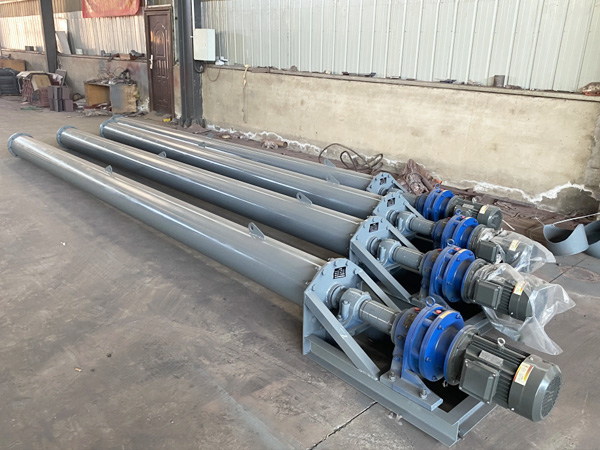
A common misconception is that the enclosed design limits feeding and discharge flexibility. In practice, the tubular screw conveyor accepts multiple inlet points through flanged feed ports cut into the tube wall. These ports can be positioned along the conveyor length to receive material from several dust collection hoppers simultaneously. At the discharge end, a full-port outlet allows complete emptying, while a reduced port or a slide-gate outlet enables metering discharge into a receiving vessel. The flexibility to receive from multiple sources and meter to a single destination makes the tubular design a natural hub in multi-point dust collection networks.
Incline and Vertical Capability
The tubular screw conveyor handles inclines up to approximately 30 to 35 degrees with standard screw geometry. For steeper applications, a stepped-pitch screw—where the flight pitch decreases toward the top of the incline—maintains material in the casing as the conveying force increases. Vertical operation is possible with specialized designs using close-clearance screws and high-strength drive units, though it is less common and requires careful engineering review. Most plant layouts use the tubular conveyor on shallow inclines between a collector hopper at grade and an elevated storage silo.
Materials of Construction
The tubular screw conveyor casing and screw are available in a wide range of materials to match the material being conveyed and the operating environment. Carbon steel is the standard choice for most industrial applications involving non-corrosive dusts. When corrosion resistance is required—conveying acidic powders, caustic materials, or materials with high moisture—stainless steel grades such as 304 or 316 are specified. For highly abrasive dusts, hard-facing on the screw flights or a replaceable liner system inside the tube extends the service life significantly. The material selection should be made based on the actual process conditions, not assumed from a catalog default.
Comparing Tubular to U-Trough Conveyors
The tubular screw conveyor and the U-trough screw conveyor serve similar conveying functions but differ in meaningful ways. The tubular design provides superior dust containment and structural strength. The U-trough design offers easier access for inspection and maintenance because the trough cover can be removed without disconnecting inlet or outlet piping. The tubular conveyor requires more precise shaft alignment and seal management; the U-trough is more forgiving of minor misalignments. For a given conveyor length and capacity, the tubular conveyor is generally the heavier and more expensive unit—but the sealed containment and structural advantages often justify the cost difference in critical service.
Drive Integration and Power Requirements
The drive for a tubular screw conveyor is typically mounted at the discharge end, where the thrust load is highest. A shaft-mounted gear reducer with a direct-coupled motor is the most compact and reliable arrangement. Drive sizing must account for the material bulk density, the conveyor length and diameter, the incline angle, and the screw speed. Higher-speed screws provide greater capacity but require more power and can cause material degradation in fragile or friable materials. Lower-speed screws are gentler on the product and consume less power but require larger diameters for the same throughput.
Frequently Asked Questions
What is the maximum incline for a tubular screw conveyor?
Standard tubular conveyors operate reliably at inclines up to about 30 degrees. Steeper inclines may require stepped-pitch screws or special flight geometries to prevent material from sliding backward in the tube.
How does the tubular design prevent dust leakage?
All joints are flanged with gaskets rated for the operating pressure and material chemistry. The round tube maintains a consistent cross-section that supports the gasket seal evenly, and there are no flat surfaces where seal compression can vary.
Can a tubular screw conveyor receive material from multiple hoppers?
Yes. Multiple inlet ports can be cut into the tube wall at different positions along the length, allowing the conveyor to receive material from several dust collection points simultaneously.
What materials are available for the screw itself?
The screw can be made from carbon steel, stainless steel, or alloy materials, and can be hard-faced or fitted with replaceable liners for abrasive service. The choice should match the conveyed material and the wear rate expected in service.
Conclusion
The tubular screw conveyor is the preferred choice when sealed containment, structural strength, and multi-point feeding are priorities. Its enclosed design prevents fugitive emissions, its round casing resists deformation, and its flexibility in inlet and discharge configuration makes it a natural hub in complex dust collection networks. Engineers specifying this equipment should focus on material compatibility, drive sizing, and seal maintenance planning to ensure reliable long-term performance.
References
CEMA (Conveyor Equipment Manufacturers Association). (2007). Belt Conveyors for Bulk Materials, 6th Edition. CEMA.
Roberts, A. W. (1999). The influence of granular flow physics on screw conveyor performance. Powder Handling and Processing, 11(2), 155–162.
Schmidt, L., et al. (2003). Design and application of screw conveyors for bulk solids. Chemical Engineering and Processing, 42(6), 421–429.
Yu, Y., & Arnold, P. C. (1997). Theoretical modelling of torque requirements for horizontal screw conveyors. Bulk Solids Handling, 17(3), 423–428.
 HOT PRODUCT
 CONTACT US