





BLOGSDETAILS
Shaftless Screw Conveyor for Sticky and Difficult Materials
Author:shangcheng Time:2026-09-09 14:35:23 Click:150
There is a class of material that defeats the standard industrial screw conveyor every time: moist ash with highlime content, biosolids from wastewater treatment, municipal sludge, dewatered slurry with fibrous inclusions, and highly cohesive dusts that cake on contact with any surface. The problem is not the conveyor mechanism in general—it is the central shaft. A shaft running through the center of the screw creates a fixed surface inside the flight path where sticky material accumulates, builds up, and eventually forces the conveyor to stall or the drive to overload. The shaftless screw conveyor solves this by removing the shaft entirely. Understanding why that change matters, and when it justifies the additional cost, is what this article covers.
What Makes the Shaftless Design Different
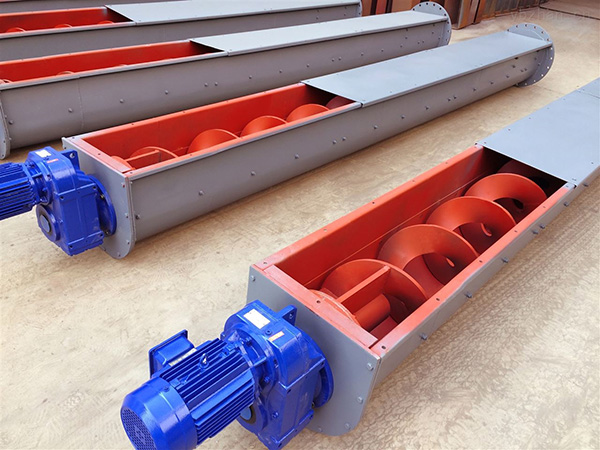
In a conventional industrial screw conveyor, the helical flight is welded to a central shaft that transmits torque from the drive to the flight face. The flight-to-casing clearance must be tight enough to push material without letting it slip backward, but tight clearance in sticky service means material adheres to the shaft and flights and accumulates layer by layer. A shaftless screw conveyor replaces the central shaft with a heavy-gauge tubular spine or a bare center section that has no surfaces for material to cling to. The flight geometry is adjusted—thicker flights, modified helices, sometimes a stepped profile—to generate enough material-pushing force without the shaft acting as a buildup surface.
Applications Where Shaftless Geometry Prevails
The shaftless screw conveyor is the solution for materials that fall into three categories. The first is cohesive and adhesive materials—lime kiln dust, cement raw meal, moist fly ash, and filter cakes—where the material wants to stick to any solid surface it contacts. The second is fibrous or stringy materials like Municipal Wastewater Biosolids, paper pulp, and food processing waste, where a central shaft acts as a wrapping surface and causes clogging. The third is materials that dewater or dry during conveying and form a hard scale on metal surfaces; the thick flight geometry of a shaftless screw is more resistant to this type of buildup and easier to clean when scale does form.
Design Features That Handle Difficult Materials
Beyond removing the shaft, the shaftless screw conveyor incorporates several design features that improve performance in challenging service. The flights are typically made from heavy-gauge plate—thicker than a standard rolled flight—to resist abrasion and deformation under heavy material loads. The flight geometry may include a reversed-helix section at the inlet to break up bridging, or a tapered section at the discharge to compress the material and improve compaction. The casing is often U-trough rather than tubular to allow access for inspection and manual cleaning when buildup does occur. The drive end uses a torque arm or stub shaft arrangement that transmits torque without requiring an internal bearing in the material path.
Trough vs. Tubular: Choosing the Right Shaftless Configuration
Shaftless conveyors are available in both U-trough and tubular configurations, and the choice depends on the material and the installation. A shaftless tubular conveyor provides the sealed containment needed for hazardous or odorous materials—such as biosolids in enclosed plants—but requires more complex cleaning access. A shaftless U-trough conveyor is easier to open, inspect, and manually clean, making it preferable for applications where material adheres aggressively or where visual inspection is required frequently. For dust handling in enclosed collector hoppers, the tubular shaftless configuration combines the sealing advantage with the non-clogging geometry that the application demands.
Drive and Trough Lining Considerations
The drive on a shaftless screw conveyor must be sized more conservatively than for a standard conveyor because difficult materials can impose significantly higher torque loads as the screw pushes against a mass of sticky material. Most manufacturers recommend a drive margin of 30 to 50 percent above the calculated steady-state requirement. For applications involving abrasive materials, the interior of the trough or tube can be lined with replaceable wear plates—typically made from hardened polymer or chrome carbide—to extend the service life of the casing. The liner can be changed without replacing the entire casing, which is a meaningful maintenance advantage in high-wear service.
Customization for Specific Process Challenges
No two difficult materials behave identically, and a capable shaftless screw conveyor supplier will customize the design for the specific material rather than shipping a catalog unit. Variable-pitch sections can be added to improve feed control at the inlet. Short reversed-pitch sections near the discharge can prevent material flooding. Specially shaped flight edges—cut at an angle or formed with a bevel—can reduce adhesion to the flight surface in specific material chemistries. Before specifying a shaftless conveyor, provide the supplier with a material sample and the full process data sheet, including moisture content, particle size distribution, and any known adhesion or caking behavior.
Frequently Asked Questions
When should I choose a shaftless screw conveyor over a standard screw conveyor?
When the material is sticky, fibrous, cohesive, or prone to adhering to solid surfaces. If a standard conveyor has required frequent manual cleaning or has suffered from recurring shaft buildup, the shaftless design will resolve those issues.
Does the shaftless design use more power than a standard screw?
For the same capacity and dimensions, a shaftless conveyor may require slightly higher torque due to the heavier flight geometry and the absence of a central shaft to assist in material movement. Drive sizing should include a conservative margin above the calculated requirement.
Can a shaftless conveyor be used in inclined applications?
Yes, up to approximately 20 to 25 degrees depending on the material. Steeper inclines reduce the effective capacity of a shaftless conveyor more significantly than a standard conveyor due to the heavier flight geometry.
What maintenance is required for a shaftless conveyor?
Routine inspection of the flights and trough lining for wear, periodic inspection of the drive and torque arm, and manual cleaning of the trough or tube when buildup is observed. The absence of a central shaft simplifies the inspection process compared to standard conveyors.
Conclusion
The shaftless screw conveyor is purpose-built for materials that defeat standard conveyor designs. Removing the central shaft eliminates the primary surface where sticky material accumulates and builds up. For cohesive dusts, biosolids, filter cakes, and fibrous materials, the shaftless configuration provides reliable conveying where a conventional industrial screw conveyor would require constant attention, manual cleaning, and frequent maintenance. Engineers who specify this equipment with full material data and appropriate drive margins will get a reliable, long-running solution that minimizes plant downtime.
References
Roberts, A. W. (1999). The influence of granular flow physics on screw conveyor performance. Powder Handling and Processing, 11(2), 155–162.
Schmidt, L., et al. (2003). Design and application of screw conveyors for bulk solids. Chemical Engineering and Processing, 42(6), 421–429.
Yu, Y., & Arnold, P. C. (1997). Theoretical modelling of torque requirements for horizontal screw conveyors. Bulk Solids Handling, 17(3), 423–428.
CEMA (Conveyor Equipment Manufacturers Association). (2007). Belt Conveyors for Bulk Materials, 6th Edition. CEMA.
 HOT PRODUCT
 CONTACT US