





BLOGSDETAILS
Industrial Activated Carbon Filter for Exhaust Systems
Author:shangcheng Time:2026-09-28 21:06:23 Click:68
When an industrial exhaust stream carries volatile organic compounds, solvents, or odorous compounds at low concentration and high volume, the industrial activated carbon filter is frequently the most practical control device. It does not burn fuel, has no flame, and operates at ambient temperature with modest pressure drop. Its limitations are equally real: it captures rather than destroys, it saturates, and it must be managed as a concentrated waste stream. Understanding how the device actually works—and where it stops working—is what separates a reliable installation from one that quietly exceeds its permit. This article covers the adsorption principle, the carbon media choices, vessel design, applications, and the maintenance discipline the technology demands.
How an Industrial Activated Carbon Filter Works
Activated carbon is a highly porous material with an internal surface area that can exceed 900–1100 m²/g. The microscopic pore network provides enormous surface for van der Waals attraction, so VOC molecules in the passing gas adhere to the carbon surface—a process called adsorption. In an industrial activated carbon filter, the exhaust is forced through a packed bed; the VOC-laden gas contacts the carbon, the organic molecules are retained, and the cleaned gas exits. Over time the available pore surface fills, the bed's capacity drops, and the outlet concentration begins to rise—the point at which the filter must be regenerated or the carbon replaced.
Activated Carbon Media Types
Not all carbon is interchangeable. The media choice determines what compounds are captured and how the bed performs.
Granular activated carbon (GAC): The standard for vapor-phase industrial activated carbon filter service. Particles range from about 4×10 to 12×40 mesh, balancing contact area against pressure drop.
Impregnated carbon: Carbon treated with chemicals (e.g., potassium iodide, copper, or acids) to improve capture of specific compounds such as hydrogen sulfide, mercury vapor, or ammonia that plain carbon adsorbs poorly.
Extruded/block carbon: Formed into honeycomb or pellet shapes for very low pressure drop in large-volume applications, at the cost of somewhat lower effective surface per volume.
Coated or catalytic carbon: Combines adsorption with a surface reaction for compounds that are hard to retain by physical adsorption alone.

Vessel Design Fundamentals
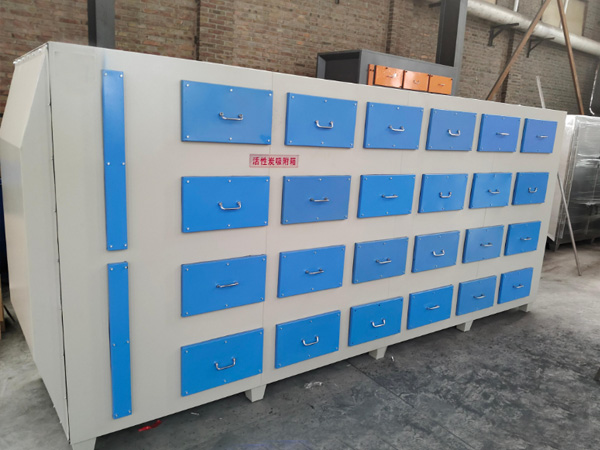
The vessel is more than a can with carbon in it. A well-designed industrial activated carbon filter vessel manages gas distribution, bed depth, and access for change-out.
Gas Distribution and Bed Geometry
Uniform flow across the bed cross-section is essential; channeling lets untreated gas bypass the carbon. Inlet diffusers and a generous inlet plenum promote even distribution. Bed depth is selected so that the empty-bed contact time—typically 0.5 to 2 seconds for vapor-phase service—is sufficient for the target compounds to transfer from the gas to the carbon surface.
Pressure Drop and Sizing
Pressure drop across the bed rises as the carbon loads and as fines accumulate. Oversizing the vessel reduces face velocity, lowers pressure drop, and extends service life, but increases capital and carbon volume. The design balances these against fan power cost. A industrial activated carbon filter specified too small will saturate quickly; one specified too large wastes carbon that may expire by age rather than use.
Exhaust Applications of Activated Carbon Filters
The industrial activated carbon filter appears across many exhaust duties:
Painting and coating lines: Capturing solvent vapors from spray booths and flash-off areas.
Chemical and pharmaceutical process vents: Controlling intermittent organic emissions where recovery has value.
Wastewater and sewage treatment: Removing hydrogen sulfide and mercaptans that cause odor complaints.
Printing and converting: Capturing ink and adhesive solvents.
Laboratory and fume-hood exhaust: Polishing low-concentration organic loads before discharge.
Saturation, Breakthrough, and Monitoring
The defining operational parameter of an industrial activated carbon filter is the breakthrough curve. As the inlet face of the bed saturates, the adsorption zone migrates through the bed toward the outlet. When the zone reaches the outlet, contaminant concentration in the exit gas rises sharply—breakthrough. Monitoring options include periodic charcoal tube sampling, online VOC analyzers at the outlet, or conservative time-based change-out based on mass loaded. Waiting for breakthrough to be obvious in the stack is poor practice; a margin must be designed in so the bed is swapped before the outlet limit is approached.
Regeneration, Replacement, and Waste Handling
Once saturated, carbon can be thermally reactivated at high temperature in a controlled atmosphere, restoring much of its capacity, or it can be disposed of as a regulated waste depending on what it adsorbed. On-site steam desorption recovers some solvents and returns the bed to service, but requires a condensate handling system. For many plants, off-site reactivation—shipping spent carbon in sealed containers and receiving reactivated material—is simpler. The industrial activated carbon filter owner must account for this logistics chain in the operating plan, because accumulated spent carbon on site is both a storage hazard and a permitting concern.
Maintenance Practices
Reliable operation depends on disciplined maintenance:
Track mass of VOC loaded versus bed capacity to predict change-out.
Monitor pressure drop for channeling or fines buildup.
Inspect inlet pre-filters; particulate fouls carbon and shortens life.
Verify seal integrity at access doors and fittings—leaks bypass the bed.
Document each carbon change-out with date, mass, and source batch.
Procurement Considerations
When specifying an industrial activated carbon filter, provide the vendor with the compound list, concentration range, flow, temperature, humidity, and desired outlet limit. Ask for the carbon type, the designed empty-bed contact time, the expected service life under your load, and the change-out procedure. Request references from similar applications. A supplier who asks about your gas chemistry before quoting is engineering the solution; one who ships a standard canister without that discussion is not.
FAQ
How long does activated carbon last in an exhaust filter?
Service life depends on VOC concentration, flow, compound affinity, and bed size. It is calculated from mass loaded versus bed capacity, not a fixed calendar interval. Monitoring or conservative load-based change-out prevents breakthrough.
Can an industrial activated carbon filter handle all VOCs?
No. Plain carbon adsorbs many non-polar organics well but performs poorly on very low-molecular-weight or highly polar compounds. Impregnated or catalytic carbon extends the range for specific pollutants such as hydrogen sulfide or ammonia.
What happens when the carbon is saturated?
The bed must be regenerated or replaced before breakthrough reaches the outlet limit. Spent carbon is a concentrated waste stream and may require regulated handling, storage, and transport.
Does an activated carbon filter destroy VOCs?
No. It concentrates them on the carbon surface. Destruction requires oxidation or another destructive technology; carbon merely captures and holds the pollutant until regeneration or replacement.
Conclusion
The industrial activated carbon filter is a proven, energy-efficient control device for low-concentration VOC and odor streams, provided it is specified and operated as a managed system rather than a passive canister. Success depends on matching the carbon media to the compound, designing for even flow and adequate contact time, monitoring for breakthrough, and planning the spent-carbon handling chain. Plants that treat the filter as a consumable with a defined service life—and that provide accurate gas data to the supplier—achieve reliable compliance without the fuel cost of thermal alternatives.
References
Ruthven, D. M. (1984). Principles of Adsorption and Adsorption Processes. John Wiley & Sons, New York.
Yang, R. T. (2003). Adsorbents: Fundamentals and Applications. John Wiley & Sons.
Sorial, G. A., et al. (1989). Evaluation of solid adsorbents for the removal of volatile organic compounds. Environmental Progress, 8(1), 39–52.
Khan, F. I., & Ghoshal, A. K. (2000). Removal of volatile organic compounds from polluted air. Journal of Loss Prevention in the Process Industries, 13(6), 527–545.
Crittenden, J. C., et al. (2012). Water Treatment: Principles and Design, 3rd Edition. John Wiley & Sons.
 HOT PRODUCT
 CONTACT US