





BLOGSDETAILS
Galvanized Filter Cage: Advantages in Dust Collection Systems
Author:shangcheng Time:2026-10-13 19:31:07 Click:69
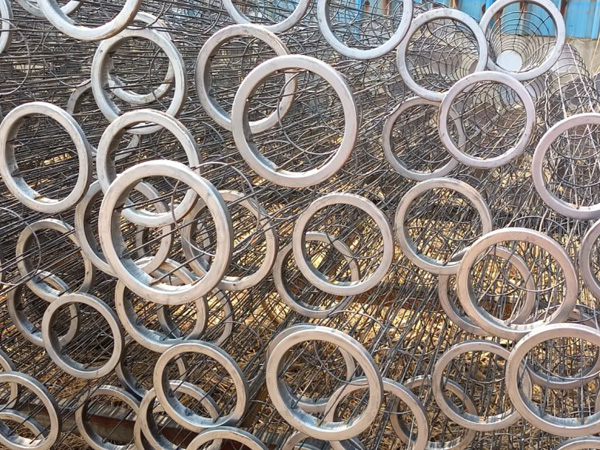
A galvanized filter cage provides essential structural support for filter bags in dust collection systems, offering superior corrosion resistance and extended service life compared to standard steel cages. This comprehensive guide examines the technical advantages, application suitability, and cost-benefit analysis of galvanized coatings for industrial dust collection applications.
Key Advantages of Galvanized Filter Cages
Galvanized filter cage products offer multiple advantages in demanding industrial environments:
Corrosion Resistance: Zinc coating provides 50-80 μm thickness, protecting against moisture, chemicals, and acidic dusts
Extended Service Life: Typical lifespan of 5-10 years in moderate environments vs. 2-3 years for uncoated steel
Cost-Effectiveness: 15-25% cost premium over bare steel, offset by 2-3x longer service life
Low Maintenance: Self-healing properties at cut edges; no touch-up painting required
Environmental Compliance: Zinc is non-toxic and recyclable; meets RoHS and REACH requirements
Galvanization Process and Quality Standards
Quality galvanized filter cage manufacturing follows hot-dip galvanizing (HDG) per ASTM A123/A123M standards. The process involves:
Surface Preparation: Degreasing, pickling (acid cleaning), and fluxing to remove oxides
Galvanizing: Immersion in molten zinc at 450-460°C for 3-5 minutes
Cooling and Inspection: Quenching, dimensional inspection, and coating thickness measurement
Coating thickness typically ranges 50-80 μm for standard applications, with heavy-duty coatings up to 120 μm available. A reputable galvanized filter cage supplier provides coating thickness certificates and salt spray test reports (ASTM B117) demonstrating >500 hours without red rust.

Application Suitability Assessment
Select galvanized filter cage for these operating conditions:
Ideal Applications:
Humid or high-moisture environments (cement, gypsum, food processing)
Acidic dusts (pH 3-6) common in chemical processing
Outdoor dust collectors exposed to weather
Wastewater treatment plants (hydrogen sulfide exposure)
Applications with frequent washdowns (food, pharmaceutical)
Not Recommended For:
Strong alkaline environments (pH >10) - zinc dissolves in caustic solutions
High-temperature applications (>200°C) - zinc coating may flake
Severe chemical exposure (acids >10% concentration)
Stainless steel required by FDA for direct food contact
Comparative Analysis: Galvanized vs. Alternative Coatings
| Property | Galvanized | Epoxy Coated | Stainless Steel | Bare Steel |
|---|---|---|---|---|
| Corrosion Resistance | Good (pH 3-10) | Excellent (chemical resistant) | Excellent (all pH) | Poor |
| Cost (Relative) | 1.2x | 1.5x | 3-5x | 1x |
| Max Temperature | 200°C | 120°C | 600°C | 400°C |
| Maintenance | Low | Medium | Very Low | High |
| Typical Life (Years) | 5-10 | 3-7 | 10-20 | 1-3 |
Installation and Handling Best Practices
Proper installation ensures galvanized filter cage performance and longevity:
Pre-Installation Inspection:
Verify coating continuity (no exposed steel)
Check for handling damage (dents, scratches >2mm deep)
Confirm cage dimensions match bag inner diameter (1-2mm clearance)
Inspect venturi (if equipped) for secure attachment
Installation Steps:
Insert cage carefully into filter bag to avoid abrasion
Use cage alignment tool to prevent bag twisting
Ensure proper seating in tube sheet (no gaps)
Verify cage verticality (plumb) within 5mm/m tolerance
Post-Installation: Perform pulse-jet cleaning test to confirm proper cage positioning and bag tension.
Cost-Benefit Analysis and ROI
Evaluate galvanized filter cage using total cost of ownership (TCO):
Cost Components:
Initial purchase: $X per cage (1.2x bare steel cost)
Installation labor: Standard (no special handling)
Maintenance: Minimal (no repainting)
Replacement frequency: Every 5-10 years (vs. 2-3 for bare steel)
ROI Calculation Example:
Assume 100 cages in dust collector:
Bare steel: $100/cage × 100 = $10,000 + 3 replacements over 10 years = $40,000 TCO
Galvanized: $120/cage × 100 = $12,000 + 1 replacement over 10 years = $24,000 TCO
Savings: $16,000 over 10 years (40% reduction)
Additional savings from reduced downtime, maintenance labor, and disposal costs further improve ROI. Most applications show payback within 18-24 months.
Specifications and Customization Options
When ordering galvanized filter cage, specify these parameters:
Standard Specifications:
Diameter: 120mm, 125mm, 130mm, 150mm, 160mm (custom available)
Length: Up to 6 meters (longer requires two-piece design)
Wire Diameter: 2.5mm, 3mm, 4mm (取决于 pulse pressure)
Vertical Wires: 8, 10, 12, 16, 20, or 24 (more wires = stiffer cage)
Ring Spacing: 6-inch standard, 4-inch for high-vibration applications
Customization Options:
Venturi Design: 70-100mm throat diameter, welded or clamped attachment
Coating Thickness: 50-80 μm standard, up to 120 μm for severe service
Special Treatments: Phosphate pretreatment for enhanced adhesion
Two-Piece Cages: For long lengths; bolted or pinned connection
Frequently Asked Questions
Can galvanized filter cages be used in high-temperature applications?
Galvanized filter cage is suitable for continuous operation up to 200°C. Above this temperature, zinc coating may soften and flake. For higher temperatures, specify stainless steel (304/316) cages with appropriate coating or bare metal.
How does galvanized coating perform in acidic environments?
Zinc provides good resistance to mild acids (pH 3-6) due to formation of protective zinc salts. However, in strong acids (>10% concentration) or low pH (<3), coating life reduces significantly. For severe acid exposure, specify epoxy-coated or stainless steel cages.
What is the typical lead time for custom galvanized filter cages?
Standard galvanized filter cage orders ship within 3-4 weeks. Custom designs (non-standard diameters, special venturi, two-piece cages) require 6-8 weeks for first-article approval and production. Order replacements proactively to avoid downtime.
Can damaged galvanized coating be repaired?
Minor damage (<2mm deep) can be repaired with zinc-rich paint (>90% zinc dust content). However, repairs never match original hot-dip galvanizing quality. For damage >5% of surface area, replace the cage. Always handle cages carefully during installation to prevent coating damage.
How do I verify galvanized coating quality from suppliers?
Request: (1) Coating thickness measurements (magnetic gauge, per ASTM A123), (2) Salt spray test reports (>500 hours per ASTM B117), (3) Visual inspection standards (no blisters, bare spots, or heavy zinc runs). Quality suppliers provide mill test reports (MTRs) for every order.
Conclusion
A galvanized filter cage delivers compelling advantages for dust collection systems in corrosive or humid environments. The zinc coating provides reliable, low-maintenance corrosion protection that extends cage service life by 2-3x compared to bare steel, delivering strong return on investment despite modest cost premium.
Select galvanized filter cage for applications with moisture, mild acids, or outdoor exposure. Verify supplier quality through coating thickness certificates and salt spray test reports. Proper specification, installation, and maintenance will ensure 5-10 years of reliable service, reducing total cost of ownership and improving dust collection system performance.
For aggressive chemical environments or high-temperature applications, consider epoxy-coated or stainless steel alternatives. Engage with experienced galvanized filter cage suppliers who provide technical support, customization options, and reliable delivery to optimize your dust collection system performance.
References
American Galvanizers Association. (2022). Hot-Dip Galvanizing for Corrosion Protection. AGA Technical Series.
ASTM International. (2021). ASTM A123/A123M-21: Standard Specification for Zinc (Hot-Dip Galvanized) Coatings on Iron and Steel Products. ASTM.
National Association of Corrosion Engineers. (2020). NACE SP0398-2020: Recommendations for galvanized Structural Steel. NACE Press.
Zhang, L., et al. (2019). "Corrosion Performance of Hot-Dip Galvanized Coatings in Industrial Atmospheres." Corrosion Science, 156, 78-92.
American Society of Mechanical Engineers. (2023). ASME AG-1-2023: Code on Nuclear Air and Gas Treatment. ASME Press.
 HOT PRODUCT
 CONTACT US