





BLOGSDETAILS
Cement Plant Baghouse Dust Collector Design Guide for Plants
Author:shangcheng Time:2026-10-07 10:59:48 Click:100
Cement manufacturing is one of the most demanding applications for fabric-filter dust collection. The gas leaving a kiln or clinker cooler is hot, the dust is extremely fine and abrasive, and the volumes are enormous. A cement plant baghouse dust collector that would perform well in a general factory fails here within months if it is specified with generic assumptions. The design has to account for temperature, abrasion, alkalis, and the continuous-duty expectation of a plant that runs for years between major shutdowns. This guide walks process and project engineers through the decisions that determine whether the collector meets emission limits and survives the campaign.
Why Cement Plants Need a Purpose-Built Baghouse
Cement dust is not a single material. It ranges from coarse raw-mill feed to sub-micron kiln bypass dust laden with alkali sulfates and chlorides. The collector must capture this range while withstanding gas temperatures that can exceed the safe limit of common filter media. A cement plant baghouse dust collector is therefore engineered around three constraints that general-purpose units ignore: high continuous gas temperature, severe abrasive wear on bags and tubesheets, and tight emission limits that are routinely monitored. Treating it as a standard catalogue unit is the most common cause of early bag failure.
The Cement Process and Its Dust Streams
Each point in the process generates a different dust load and character, and the collector design must match the stream it serves.
Kiln and Raw Mill
The kiln exhaust is the hottest, most corrosive stream, carrying alkali and sulfur compounds that attack both the dust cake and the bag surface. In many plants the raw mill is dried and ground using kiln exhaust gas, so the collector downstream of the raw mill sees variable temperature and humidity depending on whether the mill is running. A cement plant baghouse dust collector on this line must tolerate wide swings without the bags blinding or the housing corroding.
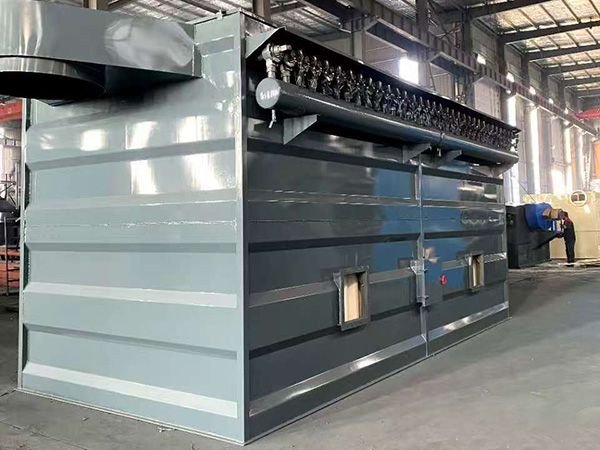
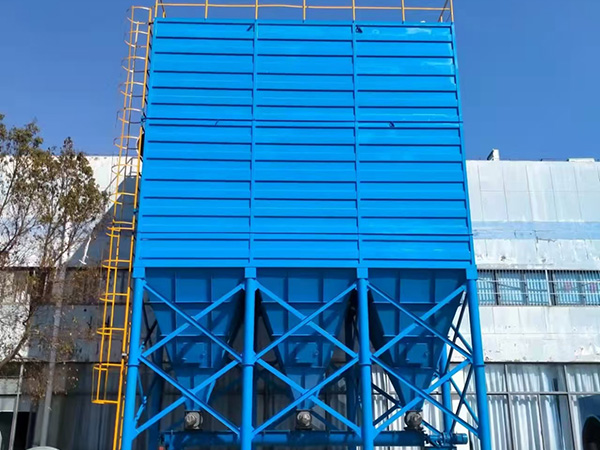
Clinker Cooler
Clinker cooler exhaust is hot and extremely abrasive because the dust is freshly cooled clinker granules with a sharp, hard particle size distribution. This stream is the toughest on bags and tubesheets. Abrasion-resistant design—hardened tubesheet surfaces, cage coatings, and conservative filtration velocity—directly extends service life here.
Finish Mill and Cement Handling
Cement finish-mill and silo-fill exhaust are cooler and less corrosive but still abrasive and high-volume. These are often the easiest streams to collect, yet they still require correct media and sizing to keep pressure drop and bag wear acceptable over a long campaign.
High-Temperature Challenge and Gas Conditioning
Filter media have an upper continuous-service temperature. When kiln or cooler gas exceeds it, the bags degrade rapidly. The standard engineering response is gas conditioning: mixing ambient air through an air-to-air heat exchanger or a tempered dilution air damper to bring the inlet temperature within the media envelope. A cement plant baghouse dust collector design must include a reliable temperature-control strategy—often a combination of a heat exchanger, a tempering damper, and a high-temperature shut-off or sprinkler trip—so that a kiln upset does not destroy the bags. Condensation is the opposite risk: if the gas is cooled below its dew point, alkali-laden moisture blinds the bags and corrodes the housing, so the minimum operating temperature is also controlled.
Abrasive Dust and Filter Media Selection
Media selection in cement service balances temperature resistance, chemical resistance, and release characteristics. Common choices include woven fiberglass bags for high-temperature kiln and cooler service, often finished with a membrane laminate that provides surface filtration so the dust cake sits on the membrane rather than penetrating the weave. Membrane finishes improve both emission control and cleanability, which matters when the dust is fine and sticky with alkalis. For cooler cement-mill and handling streams, needlefelt media in polyester or polyphenylene sulfide grades are used where temperature allows. The right cement plant baghouse dust collector media choice is driven by the actual gas temperature, the chemistry of the dust, and the desired emission limit—not by a default catalogue item.
Sizing the Cement Plant Baghouse
Sizing rests on the total gas volume and the selected filtration velocity—the air-to-cloth ratio. Cement dust is fine and abrasive, so the velocity is selected conservatively compared with general applications; a lower velocity reduces pressure drop, lowers bag flexing, and improves both capture and life. The total cloth area is the gas volume divided by the chosen velocity, and the number of compartments follows from that area plus the need for online maintenance. A cement plant baghouse dust collector on continuous kiln service is usually built in multiple compartments so one can be isolated for bag change without stopping the line. Oversizing costs capital and floor space; undersizing raises pressure drop and bag wear, so the velocity choice is a deliberate engineering trade, not a number taken from another industry.
Mechanical and Structural Considerations
Cement collectors are large, heavy, and subject to abrasive internal flow. The housing must be stiff enough to avoid deformation under negative pressure and thermal cycling. Hoppers need steep enough walls and proper discharge devices—rotary valves or screw conveyors—to keep dust moving and prevent bridging, which would force dust back onto the bags. Tubesheet and cage surfaces in the gas path are the points most exposed to abrasion and are specified with harder materials or coatings accordingly. A cement plant baghouse dust collector that neglects hopper flow or tubesheet protection pays for it in unplanned downtime.
Compliance and Emission Limits
Cement plants operate under strict particulate emission limits, frequently expressed as mg/Nm³ at a reference oxygen content, and many are monitored continuously. The collector design must meet the limit at the worst credible condition, not the average, and must keep doing so as bags age toward change-out. Documented performance—supported by differential-pressure trends and periodic stack testing—is part of the operating license. A cement plant baghouse dust collector that is specified only to the average load will drift above the limit late in the bag life, which is exactly when plants get cited.
Maintenance in Cement Service
Maintenance is shaped by the abrasive, alkaline dust. Bag-life tracking by compartment, differential-pressure trending, and scheduled cage and tubesheet inspection catch wear before it becomes emission loss. Rotary valve and screw-conveyor discharge must be watched for abrasion; a failed discharge lets dust build in the hopper and re-entrain onto the bags. Spare bags, cages, and wear parts should be stocked for the planned shutdown, because a cement line shutdown to change bags is expensive and must be completed within the window.
Procurement Data Package
To get a defensible quote, provide the vendor with gas volume and its range, inlet temperature range and dew point, dust load and particle-size distribution, dust chemistry (especially alkali and sulfur), required outlet limit and reference oxygen, available footprint, and utility conditions. The more precise this package, the more comparable vendor proposals become. A vague inquiry produces a cement plant baghouse dust collector price that may not match the actual stream.
FAQ
Why does cement kiln dust damage bags faster than general dust?
The combination of high gas temperature, fine particle size, and alkaline or sulfur chemistry attacks both the media and the dust cake. Abrasion at the tubesheet and cage also shortens life unless the design accounts for it.
How is gas temperature controlled before the baghouse?
Typically by an air-to-air heat exchanger, a tempering (dilution air) damper, or both, with high-temperature protection that isolates or suppresses the inlet if the limit is exceeded. Condensation is avoided by keeping above the dew point.
What filtration velocity is used for cement dust?
Cement dust is collected at a conservative velocity relative to general industry because the dust is fine and abrasive. The exact value is selected from the gas temperature, media, and emission limit rather than copied from another application.
Can the collector run while bags are changed?
In continuous kiln service, multi-compartment design allows one compartment to be isolated for bag change while the rest run. Single-compartment units require a shutdown for maintenance.
Conclusion
A cement plant baghouse dust collector is defined by the harshness of its duty: hot, fine, alkaline, abrasive gas moving in huge volumes under continuous operation. Reliable design comes from matching the media to the temperature and chemistry, conditioning the gas to stay within the media envelope, sizing at a conservative filtration velocity, protecting the abrasive surfaces, and planning bag change-out around the plant's shutdown window. Engineers who treat these as process-specific decisions—and who supply accurate gas and dust data—achieve emission compliance and bag life that a generic specification cannot deliver.
References
US EPA (1995). AP-42, Compilation of Air Pollutant Emission Factors, 5th ed., Vol. I, Ch. 11.6: Cement Manufacturing.
Cooper, C. D., & Alley, F. C. (2011). Air Pollution Control: A Design Approach, 4th ed. Waveland Press.
European Commission (2010). Reference Document on Best Available Techniques in Cement, Lime and Magnesium Oxide Manufacturing Industries (BREF).
Wark, K., Warner, C. F., & Davis, W. T. (1998). Air Pollution: Its Origin and Control, 3rd ed. Prentice Hall.
 HOT PRODUCT
 CONTACT US