





BLOGSDETAILS
Baghouse Filter Cage Structure and Function: A Practical Guide
Author:shangcheng Time:2026-07-31 12:16:12 Click:75
Every engineer who has stood inside a dust collector knows the quiet hero of the system is not the fan or the compressed-air line. It is the baghouse filter cage—the rigid wire framework that gives a soft fabric filter bag its shape, its stability, and its ability to survive millions of cleaning cycles. As a manufacturer that has supplied cages to cement, steel, and power plants for over a decade, we have learned that the cage is where most premature bag failures actually begin. This guide explains the structure, the function, and the practical details that procurement teams should weigh before placing an order.
What a Baghouse Filter Cage Actually Does
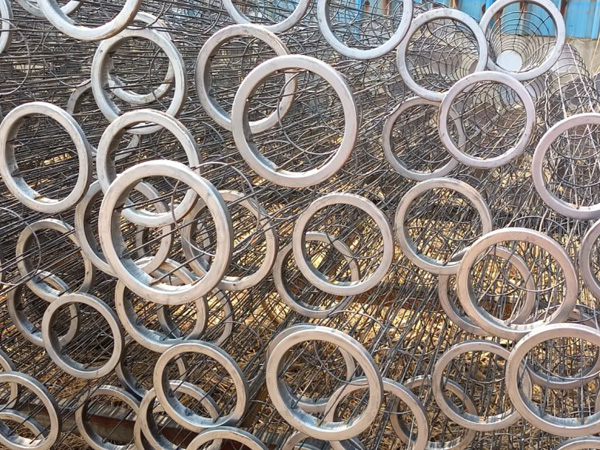
A baghouse filter cage is the internal support skeleton inserted inside a tubular filter bag. Its primary job is mechanical: it prevents the fabric from collapsing under the negative pressure of the fan and from ballooning during reverse or pulse cleaning. Beyond support, the cage defines the filtration surface geometry. A well-built cage keeps the bag fully expanded, which means the entire media area stays in service rather than bunching at the bottom. In pulse-jet collectors, the cage also acts as the conduit for cleaning energy, guiding the compressed-air shock wave down the length of the bag.
Core Components of a Standard Cage
A typical cage is assembled from four functional parts. The top cap seals the assembly into the tube sheet and houses the lift mechanism. The vertical wires—usually 10 to 24 of them depending on diameter—carry the axial load. Horizontal rings, spaced 4 to 8 inches apart, resist radial deformation and keep the cage round under suction. The bottom cup closes the assembly and prevents the bag from snagging on the hopper. When the top section includes a cone, the unit is better described as a venturi filter cage, a variant we cover later in this guide.

How the Cage Enables Pulse-Jet Filtration
In a pulse-jet baghouse, cleaning is accomplished by a short burst of compressed air—typically at 5 to 7 bar—that travels down through the cage and peels the dust cake off the inside of the bag. The cage must remain perfectly straight and round so the pulse energy is not lost to turbulence or contact with the fabric. If the verticals are out of tolerance or the rings are unevenly spaced, the bag will chafe against the wires and develop holes within weeks. We have measured cage ovality as small as 3 mm causing measurable abrasion on neighboring bags in the same compartment.
Material and Finish Selection
Material choice is driven by gas temperature, moisture, and chemistry. Carbon steel cages suit dry, ambient-duty rooms up to about 130°C. Galvanized steel adds corrosion resistance for humid streams. For acidic or high-temperature duties above typical limits, stainless grades such as 304 or 316 are specified, and in aggressive chemical plants a baked epoxy or silicone coating is applied. A responsible filter cage supplier will ask for your process gas analysis before quoting, because the wrong finish shortens service life far more than the bag itself.
Where the Venturi Filter Cage Fits
The venturi filter cage incorporates a venturi cone at the top of the assembly. This cone captures the high-velocity pulse air from the blowpipe and accelerates it into a tighter, deeper stream, pushing the cleaning front further toward the bag bottom. Plants with long bags—3 meters and beyond—see the biggest benefit, because without a venturi the pulse energy dissipates before reaching the lower section. Our factory routinely machines venturi angles between 10 and 30 degrees to match specific bag lengths and blowpipe pressures.
Manufacturing Tolerances That Protect Bag Life
Cage quality lives in the details. Wire diameter typically ranges from 2.5 to 4.0 mm; thinner wires save weight but reduce impact resistance. Ring spacing must be consistent to within ±1 mm, and the overall cage must hold a straightness tolerance under 2 mm per meter. Welds at every ring intersection should be continuous, not spot tacked, to avoid snag points. A credible filter cage manufacturer will provide a dimensional inspection report with each batch, and buyers should treat that document as part of the acceptance criteria rather than paperwork.
Handling and Installation Practices
Even a perfect cage fails if mishandled. Cages should be lifted vertically and never dragged across the floor, where abrasive debris embeds in the wires. Before insertion, inspect each cage for bent verticals or loose rings. When seating the top cap into the tube sheet, confirm a positive seal—leaks at the tube sheet let dust bypass the bag entirely. Field crews we train are taught to rotate the cage gently as it enters the bag to avoid catching the media on a ring edge.
Failure Modes and How to Prevent Them
The three most common cage-related failures are rust migration, cage collapse under suction, and bag abrasion from poor roundness. Rust transfers to the bag and creates weak spots; specifying stainless or coated cages in wet streams prevents it. Collapse is solved by adequate wire diameter and ring count. Abrasion is eliminated through tight tolerances and careful handling. In one metals plant audit, switching to tighter-tolerance cages from our filter cage factory reduced bag replacements by roughly 22 percent over a single campaign.
Frequently Asked Questions
Can cages be reused when the filter bag is replaced?
Yes, provided the cage passes inspection for straightness, ring integrity, and coating condition. Many plants run a cage through two or three bag changes before retiring it.
What wire diameter should I specify?
For most pulse-jet duties, 3.0 to 3.8 mm verticals balance weight and durability. Smaller diameters suit lightweight applications; larger sizes are reserved for high suction or abrasive dust.
How is a venturi cage different from a standard cage?
The venturi filter cage adds a cone at the top that focuses pulse air deeper into the bag. It is recommended for long bags or when cleaning efficiency needs improvement without raising air pressure.
How often should cages be inspected?
Visually at every bag change, and with a dimensional check at least annually for critical lines. Catching a bent cage early prevents a cascade of bag failures.
Conclusion
Selecting a baghouse filter cage is not a commodity decision. Structure, material, tolerance, and the optional venturi all determine how long your filter bags last and how efficiently your collector runs. Partner with a supplier who asks about your process conditions first and backs the shipment with inspection data. Doing so turns the cage from a hidden failure point into a reliability asset.
References
Dennis, R., & Klemm, H. (1980). Filter media and cleaning systems for fabric filters. Journal of the Air Pollution Control Association, 30(5), 515–522.
Cushing, K. M., & Ness, S. (2003). Performance of pulse-jet fabric filters. Powder Technology, 135–136, 343–351.
Saleem, M., et al. (2013). Numerical study of pulse-jet cleaning of fabric filters. Chemical Engineering Research and Design, 91(11), 2181–2192.
Tsai, C. J., et al. (1996). Effect of particle size and filter cake on pulse-jet cleaning. Aerosol Science and Technology, 25(4), 386–397.
 HOT PRODUCT
 CONTACT US