





BLOGSDETAILS
Activated Carbon Exhaust Treatment Applications in Industry
Author:shangcheng Time:2026-09-28 21:03:41 Click:188
Carbon adsorption is not a universal VOC solution, but within its operating window it is hard to beat for simplicity and cost. Activated carbon exhaust treatment removes organic vapors and many odorous compounds at ambient temperature, with no flame and modest energy use. The question for any plant is not "does carbon work" but "does my stream fall inside the window where carbon is the rational choice." This article surveys the industries that depend on carbon treatment, the process conditions that make it effective, the boundaries where it fails, and the ways it is combined with other controls to cover a wider duty range.
Why Carbon Fits Certain Exhaust Streams
The natural fit for activated carbon exhaust treatment is a low-concentration, high-volume stream carrying compounds that adsorb readily and a load that is steady or predictably variable. Under those conditions, carbon delivers compliance at far lower operating cost than thermal oxidation. The mismatch is a high-concentration stream (where oxidation or recovery is more economic) or a compound that carbon holds poorly (where another technology is needed). Recognizing the fit is the first step in any application review.

Painting and Coating Operations
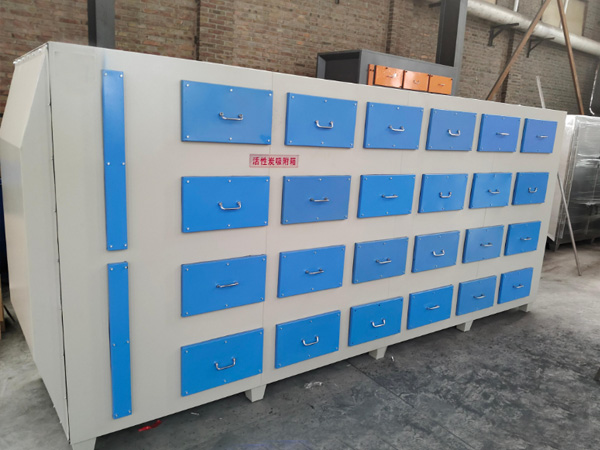
Spray booths, flash-off tunnels, and curing ovens in automotive, furniture, and general metal finishing generate solvent-laden air. A activated carbon exhaust treatment system on the booth exhaust captures the solvent fraction at low concentration. Where the solvent has reclaim value, a regenerative carbon system with steam desorption recovers it; where recovery is impractical, the carbon is replaced or reactivated. The key design input is the solvent mixture, because different solvents adsorb with different strength and desorb at different temperatures.
Pharmaceutical and Chemical Process Vents
Batch pharmaceutical and fine-chemical operations emit intermittent organic streams that vary in compound and concentration hour to hour. Activated carbon exhaust treatment buffers this variability by storing VOCs during peaks and desorbing on a scheduled cycle. The challenge is the often-complex compound mix, including compounds that may be toxic or reactive; the carbon type and any impregnation must be selected against the actual vent composition, and spent carbon handling must meet the more stringent waste rules that apply to pharmaceutical waste.
Printing and Converting
Flexographic, gravure, and rotogravure printing use solvent-based inks and adhesives whose vapors are well suited to carbon capture. A activated carbon exhaust treatment unit on the press exhaust controls both emission and odor. For high-solvent operations, recovery by desorption can offset solvent purchase cost, making the treatment system a partial resource rather than a pure cost center.
Wastewater and Sewage Treatment Odor Control
Perhaps the largest non-solvent application of activated carbon exhaust treatment is odor control at wastewater plants, lift stations, and sludge handling. Hydrogen sulfide and mercaptans are captured by impregnated carbon specifically selected for sulfur compounds. Here the value is community relations and permit compliance rather than solvent recovery. The carbon must be chosen for the target gas—plain carbon adsorbs H₂S poorly once moisture is present, so impregnated media is the norm.
Laboratories, Fume Hoods, and Small Sources
Facilities with many small, intermittent organic exhaust sources—analytical labs, R&D buildings, hospitals—often use activated carbon exhaust treatment as a polishing step on fume-hood discharge. The loads are low and variable, exactly where carbon is economical, and the absence of a flame is advantageous in occupied buildings. These systems are typically smaller vessels with conservative change-out intervals and periodic monitoring.
Performance Limits Engineers Must Respect
Carbon is not unlimited in capability. The boundaries that define responsible application are:
Saturation: The bed has finite capacity and must be changed or regenerated before breakthrough.
Compound affinity: Very low-molecular-weight or highly polar compounds adsorb weakly and may pass through.
Temperature and humidity: Heat reduces capacity; moisture competes for sites on some media.
Flammability: Adsorbed flammable solvents on hot carbon can pose a fire risk; bed temperature and desorption conditions must be controlled.
Waste stream: Spent carbon loaded with hazardous VOCs is a regulated waste requiring proper handling.
An activated carbon exhaust treatment design that ignores any of these invites either non-compliance or a safety incident.
Combining Carbon With Other Technologies
Carbon is frequently one stage in a larger train rather than the whole solution:
Carbon + thermal oxidizer: A rotary carbon concentrator enriches a low-concentration stream, then a small oxidizer destroys the concentrated fraction—cutting oxidizer fuel use.
Carbon + condenser: Desorbed solvent is condensed and separated for reuse.
Carbon + biofilter: Carbon polishes the biofilter outlet for compounds the microbes handle poorly.
Carbon + pre-filter: Particulate removal protects the bed from fouling.
This staged thinking lets activated carbon exhaust treatment cover duties it could not handle alone.
Application Selection Checklist
Before specifying carbon, confirm:
Compound list and concentration range are known.
Flow and load variability are characterized.
Temperature and humidity are within carbon's effective window.
Change-out or regeneration logistics are planned.
Spent-carbon waste classification is understood.
Outlet limit and monitoring method are defined.
FAQ
Which industries use activated carbon exhaust treatment most?
Painting and coating, printing and converting, pharmaceutical and chemical process vents, and wastewater odor control are the largest users. Laboratories and fume-hood exhaust are common smaller applications.
Can carbon treat high-concentration VOC streams?
It can, but high concentrations often make thermal oxidation or solvent recovery more economical, and high solvent loading on carbon raises fire-risk management requirements. Carbon is generally strongest at low concentration and high volume.
Why is impregnated carbon used for odor control?
Plain carbon adsorbs hydrogen sulfide and similar sulfur compounds poorly, especially in the presence of moisture. Impregnated carbon is treated to react with or retain these compounds, which is why it is standard for wastewater odor applications.
Is activated carbon treatment a standalone solution?
Often not. It is frequently combined with pre-filtration, condensers for recovery, or oxidizers for destruction. A rotary concentrator plus oxidizer is a common hybrid for low-concentration, high-volume streams.
Conclusion
Activated carbon exhaust treatment earns its place wherever low-concentration organic or odorous vapors must be removed without combustion. Its strongest applications—coating lines, printing, pharmaceutical vents, and wastewater odor control—share the characteristics of moderate-to-low concentration, reasonable flow, and predictable variability. The technology's value is realized only when engineers respect its limits: saturation management, compound affinity, temperature and humidity effects, flammability controls, and spent-carbon handling. Used within that window, and combined with complementary technologies where needed, carbon remains one of the most practical and economical controls in the industrial air-pollution toolkit.
References
Yang, R. T. (2003). Adsorbents: Fundamentals and Applications. John Wiley & Sons.
Khan, F. I., & Ghoshal, A. K. (2000). Removal of volatile organic compounds from polluted air. Journal of Loss Prevention in the Process Industries, 13(6), 527–545.
Sorial, G. A., et al. (1989). Evaluation of solid adsorbents for the removal of volatile organic compounds. Environmental Progress, 8(1), 39–52.
US EPA (1991). Control Technologies for Hazardous Air Pollutants: Part II — Adsorption. EPA/450/3-91/015.
Ruthven, D. M. (1984). Principles of Adsorption and Adsorption Processes. John Wiley & Sons, New York.
 HOT PRODUCT
 CONTACT US